
Beltane is a joyous time of warmth, longer days and growth. Where I live there will be nearly 14 hours of daylight on May 1. I wonder how many hours of daylight you will have? It depends on your latitude. Most of us cebrate Beltane on May 1, but the Celts start the celebration on the evening of April 30th and continue through May 1st. This year the moon will be a waxing crescent on this day. The lunar phase and the waxing year coincide with each other this year. This is an auspicious time for magick about growth, abundance and for energies of attraction. The moon also has been and will be waxing during the cross-quarter days this year (Imbolc, Beltane, Lughnasadh and Samhain). Cross-quarter days are the sabbats in between the solstices and equinoxes. Beltane traditionally was a day when livestock was driven between balefires and out to the pasture and in the Celtic world is the beginning of summer. You can decide if this day is the beginning of summer for yourself! Other dates to consider are June 1 (meteorological summer) or the summer solstice (astronomical summer) on June 20th this year. Just be consistent. If you choose this day as the beginning of summer, go by the Celtic calendar for the change of the seasons. You can choose to go by the meteorological calendar in which the seasons change on the first of June, September, December and March. Or you can go by the equinoxes and solstices for the change of seasons. Beltane is a time of celebrating flowers, lighting a bonfire or a candle, and dancing the maypole. You can celebrate the fertility of the garden and bees. It is traditionally a time for a handfasting, a Pagan wedding. It is a great day to be outside, enjoy nature and watch the sunrise. To learn more click Beltane Festivities. This is also a time when veil between worlds grows thin like on Samhain. As you can see in the picture below Beltane is across from Samhain on the Wheel of the Year. As it will be Beltane in the Northern Hemisphere it will be Samhain in the Southern Hemisphere, and the qualities of these sabbats although different share some similarities. The thinning of the veil is one of those resemblances. When the veil is thin on Beltane it is great time for divination and gifting offerings to faeries.

There are many forms of divination that Wiccans, Witches, Pagans and those who honor the Goddess and/or God use today: runes, Tarot cards, oracle cards, scrying, reading tea leaves and more. Some of the alphabetic systems used today for divination and magick include the Ogham (also spelled Ogam), the Anglo-Saxon runes, the Elder Futhark runes and the Younger Futhark runes. People pronounce Ogham in three ways: Ohm, Ohum, and Ogum with the emphasis on the O. I learned to pronounce it Ohum. I started working with the Elder Futhark runes and I liked them. About thirteen years ago, I stumbled across the Ogham, and I love working with that system. There is a lot of misinformation out there, so let me guide you to some trustworthy information and sources. Ogham was originally used as a system of writing, and the use of the letters for divination and magick is a modern invention. Using Ogham is a great way to rock your inner Irish! I love working with Ogham, an alphabet which has many lists of associations for each letter including a list of trees. I love trees, woodworking, and rocking my inner Irish, so working with the Ogham comes naturally to me. It has hatch marks along a central line called a stem line of which a sample is pictured. What is written in the Ogham script is my name Auburn Greene.

One good question that comes up is “Should I translate something into Old Irish before writing it using Ogham script?” Translating is difficult because you need an expert in Old Irish, and they are very hard to find. But with the help of Google and AI I translated my name into Old Irish and wrote it for you. Ruadh is Auburn and uaine is Greene. Enjoy!

Ogham is not language, but it is a system of writing. The earliest known evidence of Ogham are carvings with names in stones used as memorials and maybe territorial markers. The markings are done on large stones with the edges being natural stem lines which are vertical. The script is meant to be read from the bottom up. This tradition of carving stones is known as Monumental. The markings were also done on wood, but to find wood with those carvings that far back in time is rare. These stones were carved from the 5th to the 7th centuries after which the practice faded out. Ogham was then written in manuscripts from the 9th to the 16th centuries. This tradition is known as Manuscript. The stem lines for Manuscript are horizontal like they are in my name shown above and the letters are meant to be read from left to write. Professor Damian McManus has a great YouTube video that takes a deep dive into Ogham. To view his video click
https://youtu.be/qjLIn2DUPqs?si=cmmD2HicxR_j92ux.
He points out several important pieces of information. According him only six of the letters in Ogham have tree meanings, which was news to me! What I understood from my research is that all the letters in the Ogham are based on trees. My books give me the 20 trees with which the 20 letters called feda (plural) or fid (singular) were based. Those six feda that have tree meanings are beith (birch), fern (alder), sail (willow), nin (ash), dair (oak) and coll (hazel). For example ruis (elder) does not have a meaning of elder as I have the association on my chart. (See below.) In fact ruis has a meaning of red. Lora O’Brien says that these letters have associations with trees but not have meanings based on trees. Therein lies the difference. Note that there are many other lists of associations. To learn more check out her YouTube video by clicking
https://youtu.be/rvhK56GCtsg?si=EU7_n3fskgWW4BQp.
There are also associations of the letters in our alphabet with each Ogham fid. There is no P sound in the primitive Irish language, so there is no P fid in Ogham on stone carvings. The P fid was later added by scholars in manuscripts. Ogham was not used for writing long passages, nor was it used for writing something like a to do list. Names and short phrases were written. Another YouTube resource with good information is by Dr. Katherine Forsyth. To see her video click https://youtu.be/v3S0JxHUK68?si=YsT06VSiWwVQ3YPw.
Below I have a chart of Ogham pictured for you. It has letters of our alphabet, name of each fid, tree association, possible meanings of each fid and the written Ogham characters. Note that different sources give different meanings for Ogham, and you will have to decide what source material to use. This chart gives basic information. To learn more about Ogham check out the book titled Weaving Word Wisdom by Erynn Rowan Laurie. To get her book on Amazon click https://a.co/d/hNbx40x. In the chart there are four groups of feda called Aicme. The fourth Aicme contains the vowels. There is a 5th Aicme with feda called the forfeda which for simplicity I have not included. We do not know what letters in our alphabet go with the feda for stone carvings that have the asterisks by them in my chart. Those letters that correspond with those feda are only found later in manuscripts. Note that there are two columns under Characters. The first one with the vertical stem line is for Monumental carvings. The second one with the horizontal stem line is for Manuscript writing.
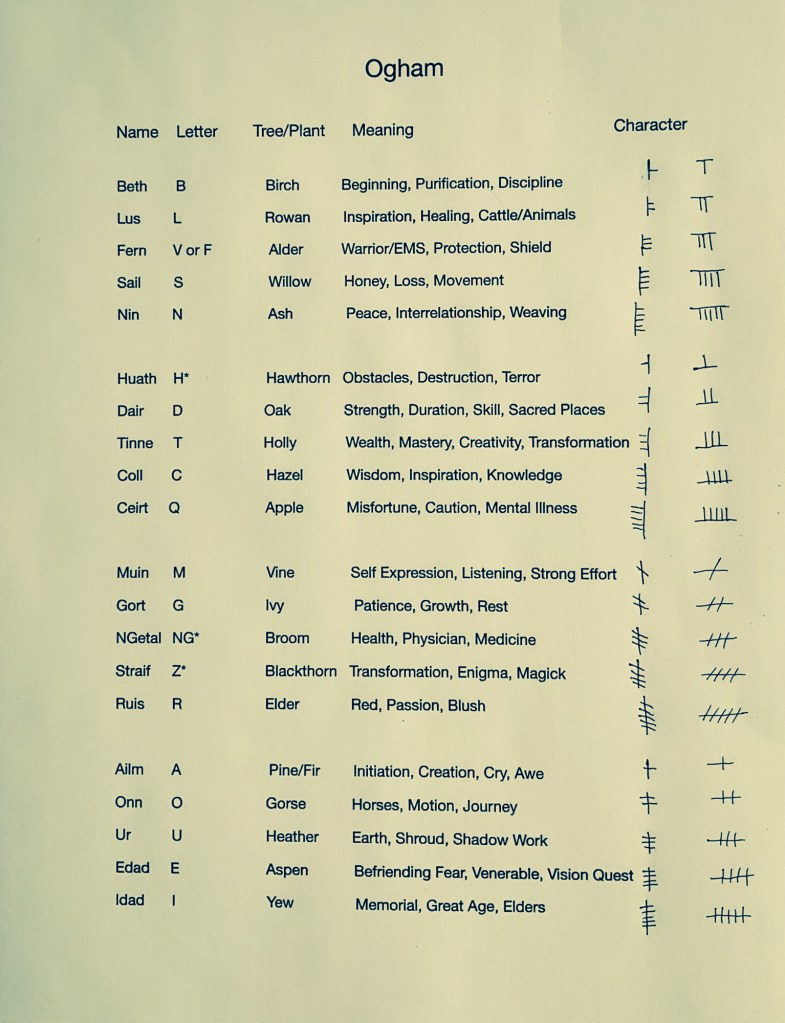
Who created Ogham? That is a mystery, but there are stories. The first evidence we have of its use is in Ireland. People who migrated from Ireland to some other parts of the UK brought the this tradition of carving Ogham stones with them. The Ogham was created by early Christians or Irish Pagans. Some people say that Ogham with the one to five hatch marks may have evolved out of a tally system. In myth a member of the Tuatha De Danann, Oghma carved on a birch twig and created the Ogham. There is a story of Ogham being invented after the fall of the Tower of Babel. These are some stories and myths of Ogham’s creation, and beyond the archeological evidence we do not know much of the story.
Some people today use Ogham as a divination tool. Traditionally Ogham was used for written words and that we know of for nothing more. Use of Ogham for divination and magick is a modern invention, and the tradition of the Ogham has evolved. I use Ogham for divination and magick with the full knowledge that I’m not using it in a traditional manner. How can you create your own divination tool? You can use tiles of wood, clay or stones. You can draw or paint the feda on a deck of blank playing cards. Or you can put each fid on a stick which is called a stave. I recommend making your own set of Ogham. These sets are pricey on Etsy, and when you make your own divination tool you develop a relationship with it. Whether you make them out of cards, tiles or sticks is up to you. If you collect sticks from the woods, you can to strip the bark completely or not. If you choose to leave the bark on, strip a small area of bark away so you have a good place to mark each stave. You may mark your staves, cards or tiles with media such as markers, carving, wood burning or painting. I chose to wood burn my set of Ogham staves as you can see in the picture below. I also chose to make mine of birch which is associated with the first fid in Ogham. I tried once to create some tiles of wood from each tree represented. But some of these are not trees but plants from which you cannot get wood such as ivy or heather. There was one wood, rowan which I simply could not obtain. It was difficult and I had to find a wood with a neutral meaning to use for those tiles. The trees/plants associated with the feda are native to Ireland. In many other parts of the world, you can find some trees like pine or oak that will suit just fine. Others like rowan do not grow in many other parts of the world. If for example rowan does not grow in your area, you might consider looking for a close relative like the checker tree or service tree. In the creation of your Ogham divination tool you need to find a way to indicate which way is up with a mark, arrow or name of the fid written out. Do what feels best to you. In my experience research is a requirement for working with Ogham, and is also ongoing. Being a life long learner means something to me.
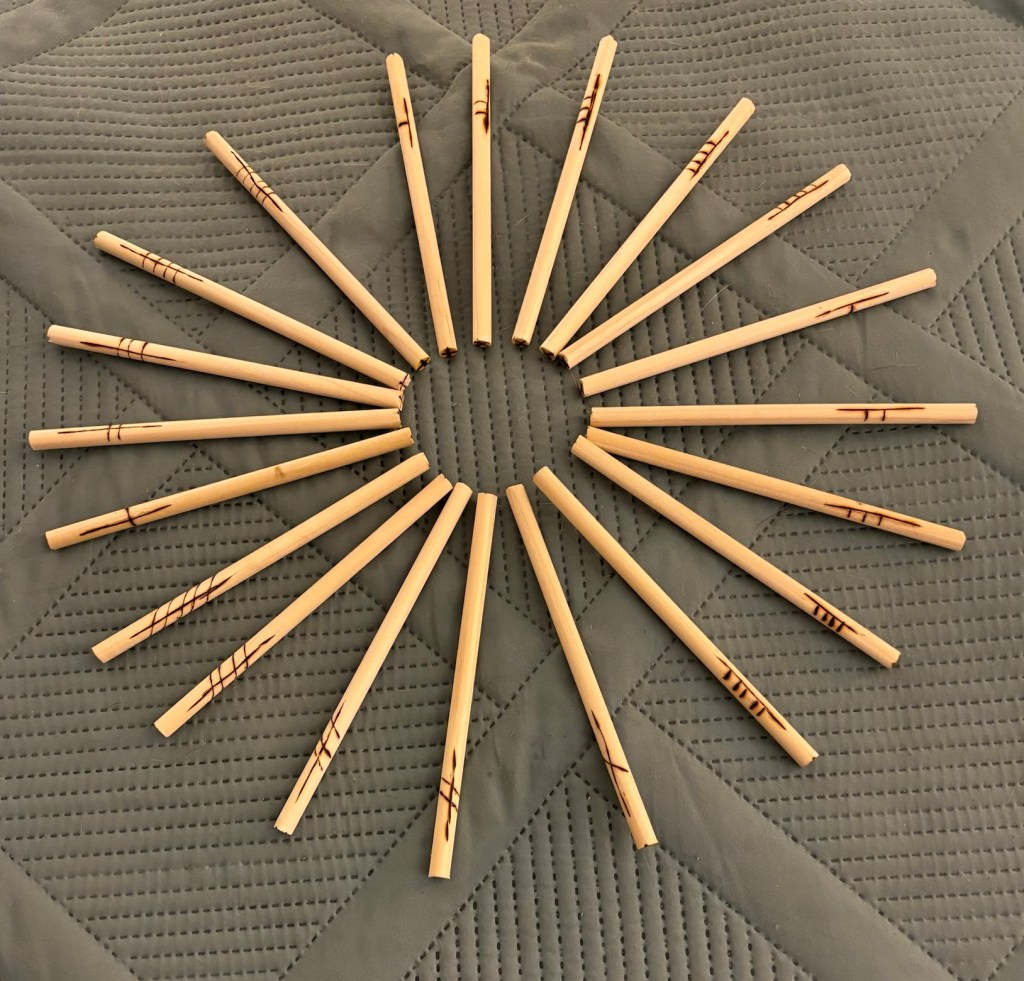
How do you use your set of Ogham once you have it? You can create spreads much like you do in the Tarot. A good place to start is the past, present and future spread or Wheel of the Year. In Wheel of the Year you draw a stave, card or tile for each of sabbats on the Wheel of the Year to look into the future. Wheel of the Year looks like the picture below. Note the eight tiles in a circle plus the ninth one for overall impression of the year. There are other spreads as well.

Some spreads focus on relations among people and situations. The key to choosing or designing spreads is to consider the question carefully. You can also cast staves or tiles. This means that you toss them, and cards would be difficult to toss properly. The key is to look at patterns and relationships among the staves or tiles. It is important to consider those that are facing up as well as facing down in the reading. It takes practice and skill to interpret casting staves or tiles.
I have also used a piece of alder separate from my set of tiles and staves to make an amulet. I inscribed it with the character for fern for protection when driving my car, and I attached it to the front bumper. You can make an amulet which protects you from negative influences or a talisman which attracts positive energies. Choose a fid and an object you want to use, inscribe the object with the character and imbue it with power. If you make an amulet, charge it at an auspicious time and put it in a suitable location. If you make a talisman, charge it under the light of the upcoming waxing moon. Carry your talisman, wear it or put it in a good location to attract positive energies to you. Enjoy divination and magickal practices this time of year with Ogham!
Have a joyous and blessed Beltane! For my friends in the Southern Hemisphere have a blessed and meaningful Samhain!
Auburn Greene
Suggested Investigation:
Forsyth, Katherine, Ph. D. “Literacy Beyond the Limes: Ogham and Pictish Symbol Writing.” Crews Project, YouTube, 5 years ago, https://youtu.be/v3S0JxHUK68?si=qJ1C63srn0rUDk6M
Hanks, Vanessa. “Beltane’s Thin Veil – Understanding the Spirit Year.” Spindle and Root, April 22, 2021, https://spindleandroot.com/2021/04/22/beltanes-thin-veil-understanding-the-spirit-year.
Laurie, Erynn Rowan. Ogam: Weaving Word Wisdom, Immanion Press, July 31, 2007. To get this book on Amazon click https://a.co/d/hOrIXkl.
McEwan, Emily. “The Ogham Alphabet.” Gaelic.co, April 26, 2017, https://gaelic.co/ogham/
McManus, Damian, Ph. D. “Ogam: Ireland’s Oldest Alphabet.”YouTube, Armagh Robinson Library, YouTube, 3 years ago, https://youtu.be/qjLIn2DUPqs?si=S9obgsjw8uQ4hLUO
McManus, Damian, Ph. D. Ogam Stones at University College Cork (University Heritage), Cork University Press, January 1, 2004. To get this book at Amazon click https://a.co/d/iHnfZq4.
Nickel, Audrey. The Irish Gaelic Tattoo Handbook: Authentic Words and Phrases in the Celtic Language of Ireland. Brandan Press, May 2, 2017. A must have if you want to get a tattoo translated in Irish. To get this book at Amazon click https://a.co/d/j1H78WE.
O’Brien, Lora. “How to Make an Ogham Set.” Ogham Academy, YouTube, 4 years ago, https://youtu.be/0p7BxD3jjOM?si=Y6qGdKNDkRp9QKRC.
O’Brien, Lora. “How to Write Ogham.” Ogham Academy, December 6, 2022, https://www.ogham.academy/blog/how-to-write-ogham?cid=a69da7c0-dc3d-4c94-a70a-d236b3b32927
O’Brien, Lora. “What Is Ogham and How Is It Used?” Ogham Academy, YouTube, 1 year ago, https://youtu.be/rvhK56GCtsg?si=EU7_n3fskgWW4BQp

 My Inner Wiccan