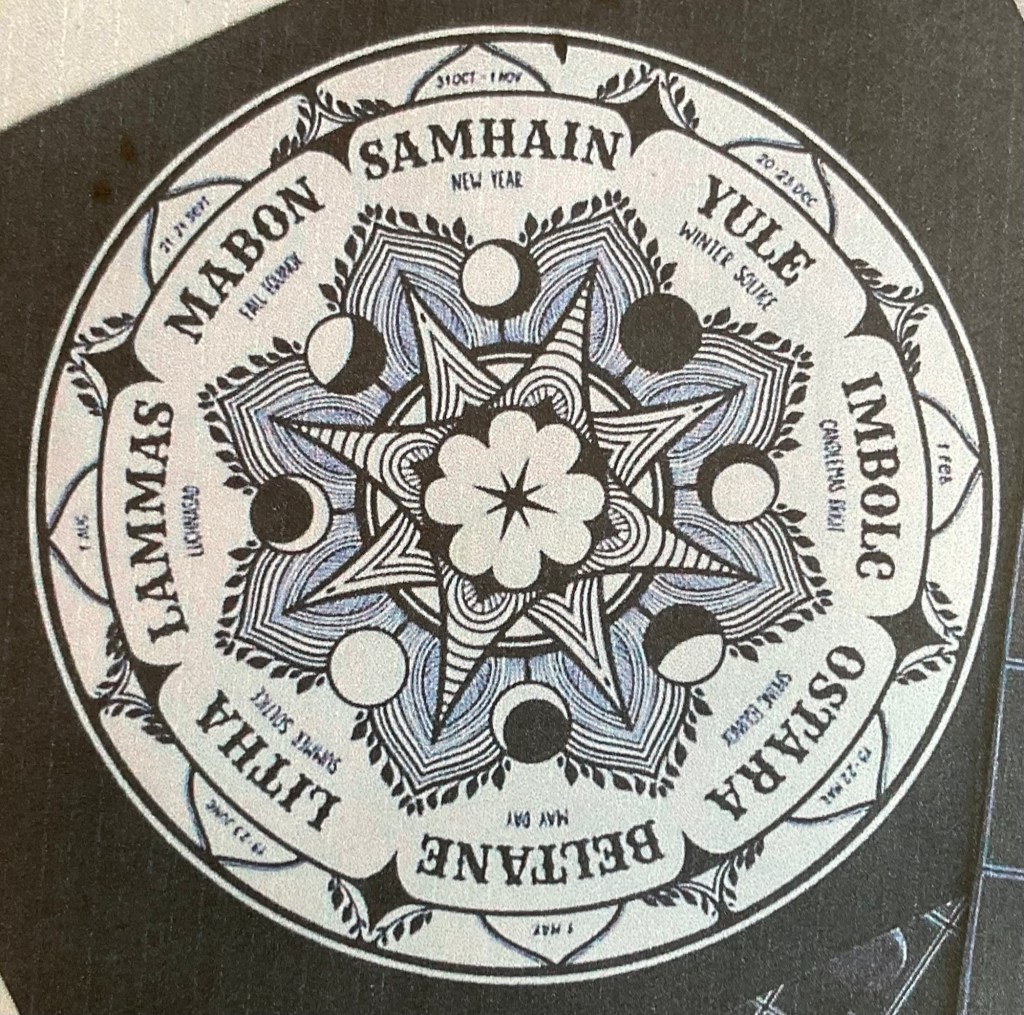
The autumn equinox also known as Mabon will occur on September 22, 2025 at 2:19 pm Eastern time. This marks the second harvest, featuring fruits and vegetables like apples, gourds and cranberries. What is ready to harvest where you live? On this day the moon will be shifting from a dark (new) moon to a waxing crescent, making it a wonderful time for new beginnings. Perhaps there are some energies that you want to cultivate and harvest later on Samhain or on the Harvest Moon. The Harvest Moon, which has a long held significance in agrarian societies, is the full moon closest to the equinox. Before electricity people relied on its light to bring in the harvest, often working both day and night. This year the Harvest Moon will be October 6 and will be a super moon. You can celebrate the gifts of this second harvest of the year on September 22 or on the harvest moon. Click HERE to learn more about the harvest moon. Mabon is also the time when Wiccans, some Witches, Pagans and those who honor the Goddess and/or God celebrate a form of thanksgiving. Click HERE to see my article about celebrating Mabon.
For Ostara this year I wrote about the goddess Eostre after which Ostara is named. Since Ostara is across the Wheel of the Year from Mabon, I decided to explore the naming of the autumn equinox and some of the gods and goddesses associated with this sabbat. The sabbat Mabon takes its name from the Welsh god Mabon ap Modron so I’ll start with him. Mabon ap Modron simply means “son of Modron,” and Modron is a Welsh earth goddess. The name Mabon for the autumn equinox is relatively recent, and was named by Aidan Kelly in the 1970’s. Let us continue with pronunciation of his name. The gods appreciate it if their names are spoken correctly. Some people pronounce Mabon as MAH-bon or MAH-pon. Others pronounce MAH-bn or MAY-bon although there are some people who bristle at that last pronunciation. One tale of Mabon speaks of his fateful rescue. Mabon, son of Modron, was stolen from his mother when he was but “three nights old” and cast into a dark and secret dungeon. In distant days, a man named Culhwch loved Olwen the daughter of a fearsome giant. Yet the giant would not easily grant her hand in marriage. Instead, he set Culhwch a perilous, nearly impossible task: to hunt and retrieve a razor, comb and shears from between a terrible boar’s ears. Some stories say to claim a tusk from this boar. For this trial, Culhwch required the aid of Mabon, who was the only one in all the world able to master a hound named Drudwyn. Culhwch sought the help of his cousin, King Authur (yes, that Arthur, the legendary king of Camelot.) Arthur sent out messengers, among them Gwrhyr, master of all tongues, even the secret speech of beasts and birds. But Mabon had been lost for countless years, his fate unknown. So Gwrhyr turned to the oldest beings of the land. First he questioned a blackbird older beyond reckoning, then a stag older still, then an owl, and then an eagle, each older than the last. None knew where Mabon lay. At last, Gwrhyr came to the oldest creature of all, a salmon. And the salmon revealed what none else could: the place of Mabon’s captivity. Arthur gathered his knights and rode beside Culhwch. Together they fought bravely and freed Mabon from his prison, restoring him to the free world. Once free Mabon located the dog and helped to obtain the treasures from his boar. Culhwch was then free to marry Olwen. To hear this exciting story visit this YouTube video and click HERE.
Persephone is a goddess who can be honored or worked with at this time of year. Her name is pronounced per-se-FON-ee. Her Roman counterpart is Proserpina pronounced pro-SIR-pin-uh. There are many tales of Persephone, each recounting the turning of the seasons. The most famous tells how she was taken by Hades, carried down into the shadowed halls of the Underworld. There, she tasted six crimson seeds of the pomegranate, and by that act was forever bound to the realm of the dead. A bargain was struck: she would spend half the year below in darkness, and half above in the bright world with her mother, Demeter. Yet there are gentler tellings too, where Persephone claims her own fate. In one ancient Minoan tale, she is called Kore, pronounced KOR-ee before her descent, and Persephone thereafter. Kore came to know of the wandering souls below and their sorrow, and her heart stirred with compassion. She told her mother Demeter what she had learned and declared her resolve to go. Though Demeter resisted, she helped her daughter prepare for the journey. While Kore was gone, Demeter abandoned her sacred duties, and the once-fertile fields grew cold and barren. Thus fall and winter came into being. And when Persephone returned each spring, mother and daughter together restored the land, bringing blossoms and grain back to life. There is an argument as to whether a pomegranate would make a good offering to Persephone. Consider which version of the story resonates with you and how she might feel about pomegranates before offering her one. Other offerings include bread, honey or flowers. Check out this YouTube video to hear another telling about Persephone and the choices she makes, click HERE. To learn more about working with her in this article click HERE.
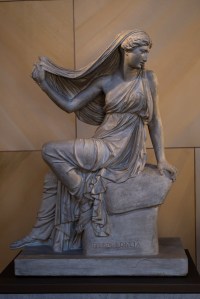
One may call upon the goddess Demeter, she who blesses the fields. Her name is spoken in Greek as thee-MEE-ter, and to the Romans she is known as Ceres, pronounced SIR-ees. She is the golden mother of grain, yet her bounty extends to fruits and vegetables as well. Often she is pictured with a sheaf of wheat or barley cradled in her arms. To honor her, offer the gifts of the land are freshly gathered grain or produce from your own land. A song of harvest, sung with reverence, will also delight her. Here is one such chant:
O mighty Demeter,
You who make the harvest sweeter,
You who grant fertility to the fields,
Bringer of abundance and wondrous yields,
I offer my praise to the power you wield.
And if your heart delights in wine and merriment, you may turn to the Roman god Bacchus, god of revelry, or to his Greek counterpart Dionysis. BAK-us is the pronunciation of his name, while the Greeks call him die-oh-NYE-suhs. He is the god of theater. He is the lord of wine, fertility, and ecstatic joy. In these months, when the grapes hang heavy upon the vine, we remember Bacchus, who taught mortals the sacred art of tending grapes and crafting wine. Yet take heed: drink to him with reverence, never in excess. Bacchus rewards joy and celebration, but those who mock or defy him have been driven to madness. Treat him with honor, and he will share his gift of ecstatic delight.
And then there is Vertumnus, pronounced ver-TOOM-nuhs, the Roman and Etruscan god of the turning seasons. He governs the tender shoots of spring and the ripened fruits of autumn. His heart belonged to Pomona, the nymph of orchards and fruit trees, who carried her basket of fruit yet spurned all suitors. But Vertumnus, ever the shapeshifter, donned the form of an old woman and came to her side. He wove tales of love lost and the sorrow of living untouched by affection. When her heart softened, he cast aside his disguise, revealing his true self, and Pomona’s heart bloomed like her orchards. Thus were they united: a god of change and a maiden of fruit, bound in love beneath the turning of the seasons. What a match!
Across the Nile’s fertile floodplain reigns Renenutet, pronounced REN-en-oo-tet, the cobra-headed goddess of harvest and fierce protection. Her gaze alone could strike down those who threatened the grain. Shrines to her were raised within the granaries, and rats and mice dared not pass her watchful eye. She is as generous as she is fearsome, a guardian of abundance. Lotus blossoms, water lilies, or a sheaf of wheat make fitting offerings to this serpentine protecter.
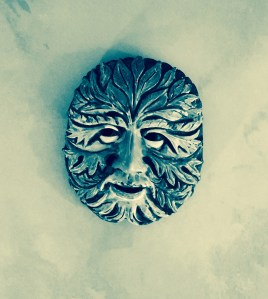
Greeen Man is yet another spirit to honor in this turning of the year. He is not a single god like Persephone or Bacchus, but rather the wild and leafy counterpart to Mother Nature herself. The name “Green Man” is a relatively new one. In the 1930s Lady Julia Raglan coined the related term “Jack in the Green.” Yet the Green Man’s visage is far older. Carvings of his leaf-crowned face appear in European churches as early as 400 A.D., and his likeness has been found across Asia and Africa as well. None, however, have been discovered in the early Americas. As you see in the image above, the Green Man’s face is woven with leaves, sometimes tangled with curling vines. Tendrils sometimes seem to spring from his nose and mouth, as though the very breath of nature flows through him.
Cernunnos, pronounced CAIR-noo-noss is a figure veiled in ancient mystery. The image below is taken from the famed Gundestrup Cauldron crafted around 100 BCE. It is an extraordinary work of sacred art. Upon its silver surface a man crowned with great antlers sits in serene majesty. In one hand he holds a torc, symbol of power. In the other hand he grasps a horned serpent alive with primal energy. Around him gather the creatures of the wild such as deer, wolves, bulls, and more, although only a few are shown in the image below. Many believe this to be an image of a shamanic figure, the Horned God himself, lord of beasts and forests. No writings from the Celts of that distant time speak of Cernunnos, yet the Romans associated him with their god Mercury, patron of travelers and commerce. Among modern Pagans, he is honored as a god of the liminal, the one who moves freely through the realms of the living and the dead. Tradition tells that the Horned God offers himself in sacrifice with the turning of the seasons. Some say at his death occurs on Lughnasadh, others say on Mabon. His death mirrors nature’s own fading at summer’s end. On Samhain he throws open the gates to the Underworld, allowing the worlds of the living and the dead to meet. As such Samhain is an auspicious time for divination. And with the returning light of Yule, he is born anew, the eternal cycle beginning again. To learn more check out Jason Mankey’s book the Horned God of the Witches. To find it on Amazon click HERE.

Herne (pronounced HURN) is the wild hunter of legend. In a nod to Cernunnos, he is most often seen crowned with antlers upon his brow. Once, they say, he served as the king’s own huntsman, swift and sure with bow and hound. But the tales of Herne are tinged with sorrow. In many tellings, driven to despair, he hanged himself from a mighty oak, which is the tree that bears his name in Windsor Forest. Even Shakespeare wove his ghostly image into verse. Is he a god or a restless spirit? That choice belongs to you. If you believe him to be a wandering soul, you may offer prayers that he find peace beneath the turning boughs. To learn more of his story, seek out the article linked HERE. And if you would honor him, bring offerings he favors, mead and venison. Better still if you craft the mead with your own hands and prepare the venison yourself, for gifts made with labor and care carry the deepest distinction.
With all the gods and goddesses he had to choose from I wonder why Aidan Kelly decided on Mabon to name this sabbat? Apparently, he was looking for a myth of Gaelic god whose myth mirrored (kind of sort of) that the popular myth of Persephone and Demeter. You can decide what to call this sabbat. You may call it Mabon, the fall equinox or the autumn equinox. You can decide which god or goddess listed above to work with on Mabon. You can also work with a god or goddess with whom you have a relationship. Or you can to decide to go more generic and work with the Universe, the Goddess and/or the God. As a practitioner you have the power and authority to make these decisions and write your own ritual. Having this power is very freeing, but it carries responsibility. As Wiccans, Witches, Pagans and those who honor the Goddess and/or the God know, you can decide what energies to put out into the Universe, and you are also responsible for their effects.
To all of my friends enjoy this sacred time of balance. To those of you in the Northern Hemisphere have a bountiful harvest, and to those of you in the Southern Hemisphere revel in the warming of your world.
If you like what I wrote, please click the like button below.
To subscribe and email notifications when I publish please subscribe below.
To leave a tip in the tip jar and keep there post coming click gift at the top.
Auburn Greene
Suggested Investigation:
Elding, Ash. “Mabon: The Pagan Celebration of the Fall Equinox.” The Pagan Grimoire, July 17, 2025, https://www.pagangrimoire.com/what-is-mabon-how-to-celebrate/.
Hughes, Kris. “12 Days of Celtic Myth II – Day 10 Mabon ap Modron.” YouTube, 1 year ago. https://youtu.be/MXshG2EVtNY?si=CF8t9FdDczK3H2Is
Living Mythology. Greek Mythology: Persephone and Hades – A Mother’s Rage.” YouTube 1 year ago, https://youtu.be/r2csLjjwmfQ?si=OPzK0BTjNXdNRqZM.
Mankey, Jason. The Horned God of the Witches Llewellyn, June 8, 2021. To find it on Amazon click https://a.co/d/aEUwr4K. Also available on Goodreads, Kindle Unlimited and Audible.
Myth Paws. “The Myth of Hades and Persephone – Greek Mythology.” YouTube, 2 months ago, https://youtu.be/D4T4YMBMaKQ?si=wEGXXQxqCf-QHWzi
9 World Chronicles. “Renenutet the Snake Goddess, Kemetic Netjer Assicated with Protection.” YouTube, 5 years ago. https://youtu.be/U9ovwv9cKuM?si=4w6rlY7eP2OFxpsq.
Story Crow. “Cernunnos & the Horned God – Celtic Deity or Ancient Guide to Mankind. YouTube, 1 year ago, https://youtu.be/Mvy83AWNPR4?si=_cWngib8Knf4xO_2.
Tea and Rosemary. “Persephone: The Archetype & How to Worship or Work with Her.” September 15, 2021, https://teaandrosemary.com/persephone-goddess/.
Wigington, Patti. “Herne, God of the Wild Hunt.” Learn Religions, April 22, 2018, https://www.learnreligions.com/herne-god-of-the-wild-hunt-2561965.



 My Inner Wiccan